
I’ve been keeping an eye and an ear on the AI music scene, Suno et al, and while opinions and perspectives run wild, I believe AI-generated music is becoming its own thing — a new category entirely. It has purpose, it has an audience, and it’s growing fast, but it is not the same as human-made music.
Human made music, broadly, has organic voices, real instruments, and live performances, all supported by years of practice and skill-sharpening. Human music doesn’t start as a recording, it starts as something organic, and is captured or recorded into something tangible. AI music starts as something recorded/captured. A prompt that is typed does not equal a voice that sings or a guitar that is strummed.
AI music existing is not a problem, per se. The problem is that some groups, whether intentionally or by default, are of the mind that AI-generated music and human-made music are the same thing, crediting themselves as artists for typing prompts, and building authority structures around something they didn’t actually create. That is the idea that this article will explore.
Key Angles
[Click here to view reference material.]
The Generative AI Creative Class Is Forming
I stumbled on some Facebook groups for AI music makers, and what I discovered was shocking, though not surprising once I dug into it.
AI music communities (Suno Creator’s Universe, etc.) are forming their own ecosystem. Members share tracks, critique each other’s output and build playlists, just like a human-made music scene. In a way, it is a scene, and it’s unfair to say it isn’t, despite what the scene is formed around.
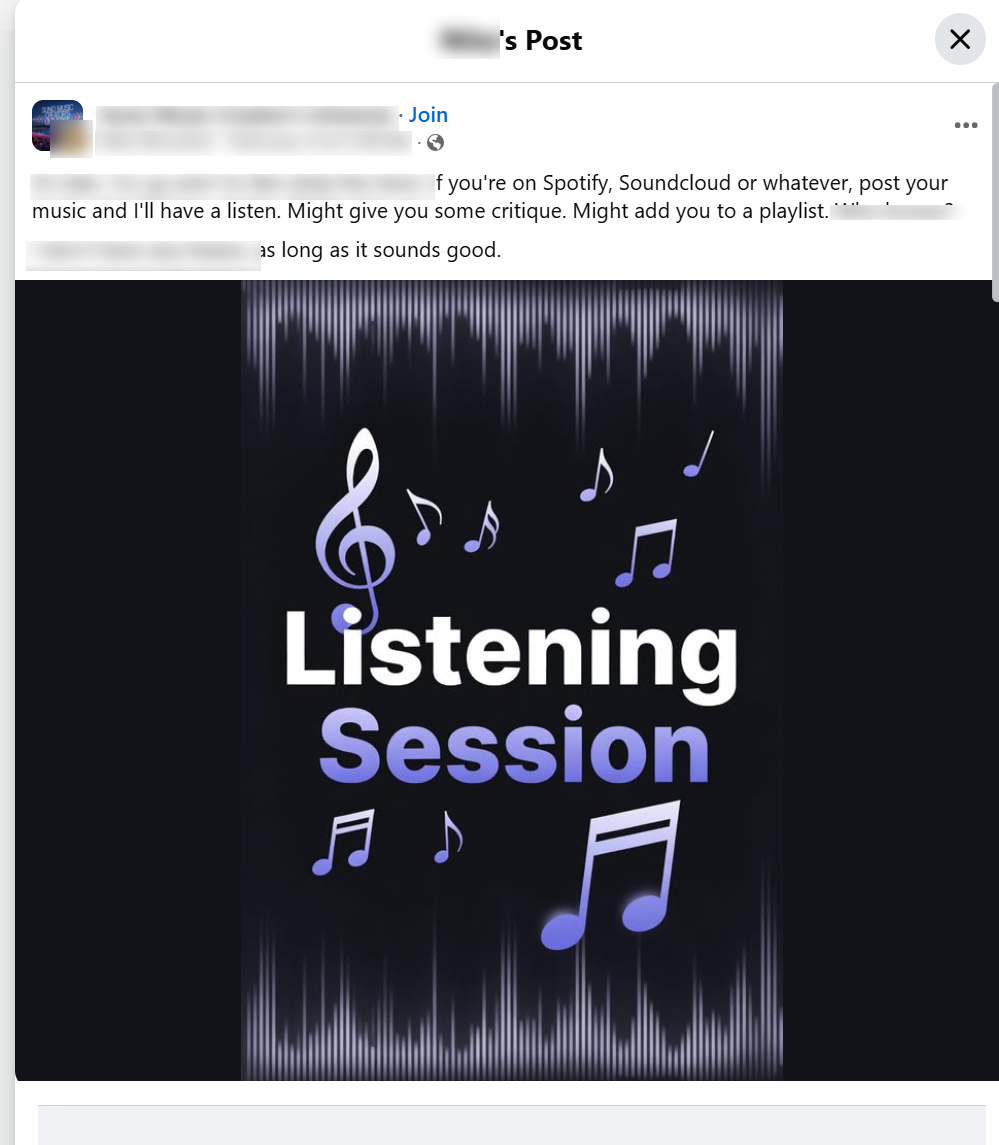
Notable members in these groups are offering to “critique” AI-generated songs, holding “listening sessions” as if they’re A&R reps or experienced producers. What authority are they critiquing from?
The Crediting Problem
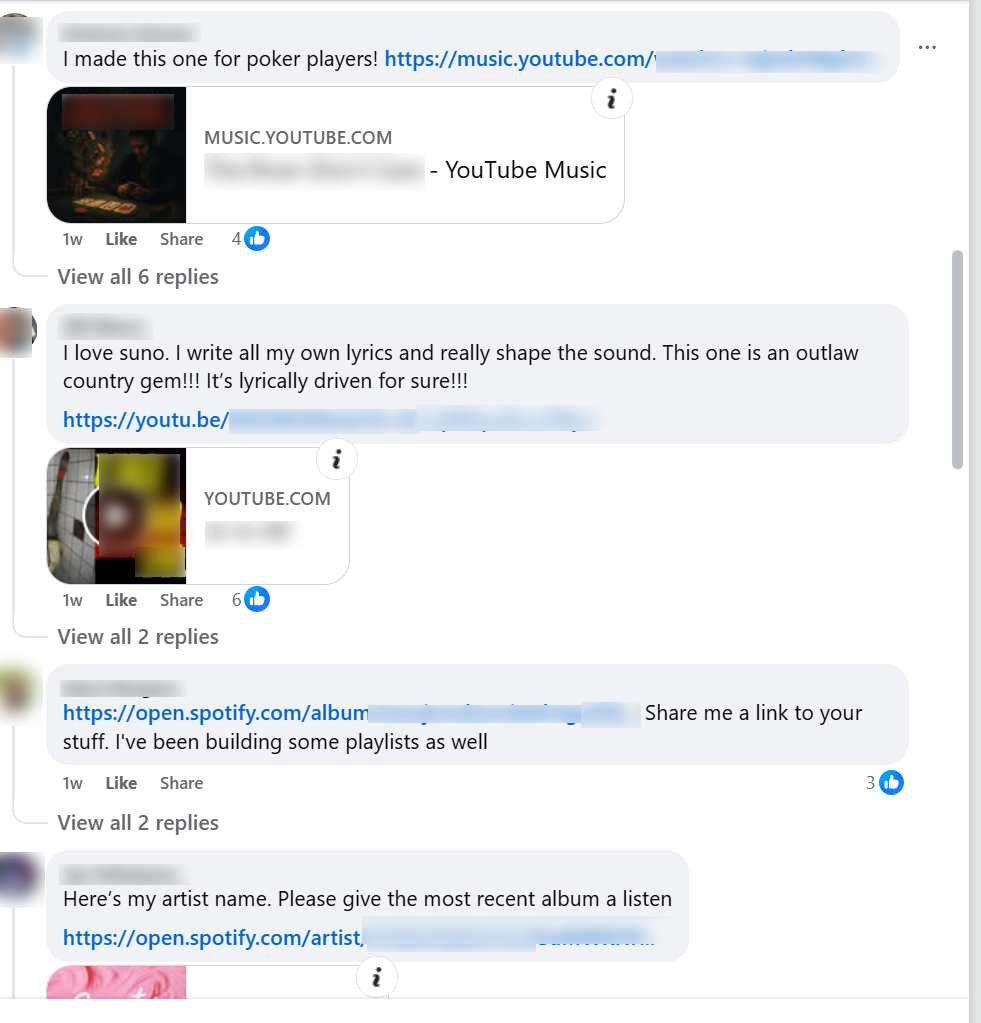
Creators in these groups say things like “I write all my own lyrics and really shape the sound” about Suno-generated tracks. Okay, they wrote lyrics (allegedly) and fed them to an AI machine. That generated the vocals, the instrumentation, the arrangement, the mix, and the master. That’s not nothing, but calling themselves “the artist” is a stretch. They are “the prompter,” which is a new role, distinctly different from that of an artist.
“Shaped By”
While exploring these AI-generator music groups, I encountered a new credit line that didn’t exist before AI music: “shaped by.” They invented a new verb because none of the existing industry verbs applied, and instead of that being a moment of self-awareness — “oh, I didn’t actually write, perform, or produce this” — it became a badge; a new title to wear. The language is doing backflips to avoid saying “generated by AI, prompted by me.”
They didn’t shape anything but a prompt. Producers and writers do the shaping. They outsourced the part that would have truly made it theirs, the part that distinguishes artists from prompters: the translation of feeling into form. That translation is the art.
There are people who genuinely enjoy making things with Suno, who get creative satisfaction from it, and who share it with communities that appreciate it. That has value that shouldn’t be underscored. But it’s a different kind of value than someone who spent 10 years learning guitar, or a vocalist who trained their instrument, or a band that plays live shows.
The Danger
When the line between “I made this with AI” and “I made this” disappears, it devalues the people who actually did make it.
The Bigger Picture
AI music is to human-made music what digital art generators are to painting: an entirely new medium. These mediums can coexist, but calling them the same thing is disrespectful to the craft it’s imitating.
What AI Music Actually Is (Outside the Music Industry)
AI generated music, when generated for personal satisfaction, should be considered the same thing as any generative product or game: passing time and getting a dopamine hit. But SUNO and any forthcoming platforms are engineered to make the user feel empowered, important, and… ahem… creative. That teeters on a betrayal of true artistry.
Ego Inflation Is by Design
AI generated music gives the prompter a false sense of accomplishment. You typed lyrics into a box and a machine made a song, and the platform’s UI/UX is built in a way that makes you feel like an artist. That feeling is the product. Big tech selling dopamine in a new format, under the guise and protection of “this is art.”
A Counterpoint: Music as Personal Utility
There is a genuinely positive use case that’s emerging alongside the problematic use cases: personal music. Music made for the individual by the individual, and not for a commercial purpose or audience.
With the onset of AI generated music, recorded music may be splitting into two categories: commercial/mass use (the industry) and personal use — literally personal use, like a household appliance. A washing machine. A stove. Those things used to be communal. Now most everyone has one. And now, with fully AI generated music, everyone can make a lullaby or a pump up song for themselves.
Music is a pill, a prayer, an incantation. Words mean almost nothing to many of us right now, but music, sung words, break through. It bypasses the defenses of distrust, nihilism, and sarcasm that genuine meaning is up against.
Making a song for yourself — a prayer, an affirmation, a chant, a lullaby for your own child — that’s not the same as typing a prompt and calling yourself an artist. That’s using a tool (music) for its most ancient purpose: metaphysical/spiritual transformation, personal comfort, and personal empowerment.
The problem isn’t the technical generation of the music, but rather the performance and/or commercialization of it; the conflation of artistry and prompting, the need to publish it, get critiques, or build a following. When generative music becomes about audience and identity, it crosses from personal utility into synthetic accomplishment.
The Bigger Case — Music’s Reputation as a Transformative Device
Look at the heart these AI-gen creators pour into their songs. Strip away the identity performance and you will see that what is underneath is real: people who have potentially never felt heard, finally feeling validated. Their desires, their pain and their needs being sung back to them in song form. For maybe the first time in their lives, someone (something) is singing exactly what they feel. Ironically, that’s humanity.
For most of human existence, music has been more than entertainment, but modern industry hijacked it, shaved it down to its current, narrow thematic state and turned it into a consumable product. They commodified the medicine. For decades, music has been classified, culturally, solely as “entertainment” and more recently, just “content.” AI music, ironically, might be what restores its older, truer reputation: music as medicine.
Right now, streaming and AI-gen music has turned the music industry into the wild west. The categories are blurred, the language is confused, and people are calling themselves artists when they’re really patients self-medicating with sound and sharing their prescription. But the wild west was tamed, and so shall the music industry landscape. When the dust clears, I predict that music will have reorganized into clear silos:
- Organic Commercial / Industry — professional artists, performers, producers. Music as a craft, lifestyle and way of life driven by humans for humans. Like art galleries and museums, but for music.
- Communal / Populace Scale — shared cultural music. Playlists, streaming, short form trending audio: the background soundtrack of collective daily life. Like Netflix, but for music.
- Generative Personal use — music as private utility. Healing, prayer, affirmation, self-expression with no audience. Made for yourself, by yourself, using whatever tools are available. Like medical prescriptions, but music.
If we can educate people about this distinction by naming and framing it clearly, it could be a turning point. Not just for how both sides of the AI-generated music argument, but for how humanity classifies music itself. Music breaks out of “entertainment” and goes back to being what it always was before the record label era: something humans do for themselves or with each other, and for divine purposes, however small or mighty. The industrialization holding music captive then becomes a 100-year detour.
The Money Problem: Non-Artists Taking From Artists, at Scale
So far, I’ve talked about an idea, but the idea isn’t just an intangible abstraction of thought, it already has real financial implications.
People who are not artists are uploading AI-generated tracks to the same platforms real artists depend on for income, inflating competition for the same streams, the same playlist spots and the same algorithmic attention, all from the same revenue pool. They are literally taking money from real, working artists. Directly. Without shame, but for many, probably without even knowing.
The streaming revenue pool is finite. Every stream of an AI-generated track is a stream that didn’t go to a human artist. Every playlist slot occupied by a Suno track is a slot a real musician lost. Every save, every follow: all pulling from the same, finite ecosystem. For the most part, the people doing it think they’re just “sharing their music.” They don’t see themselves as taking from anyone. They’re not malicious, they’re oblivious (and so are most of the fans/listeners.)
This is a clusterfuck that is getting exponentially bigger. The volume of AI-generated content is increasing faster than any human music scene ever could because there’s no delay between idea and execution (good for software development, bad for existing music industry.) No practice, no recording sessions, no mixing, no mastering time or cost involved. One prompter can generate dozens of tracks a day. Multiply that by hundreds of thousands of prompters and now, the streaming platforms are being flooded with synthetic content that dilutes the entire ecosystem.
Yet, the platforms don’t care. Spotify, Apple Music, YouTube — they get paid regardless of whether the stream was human-made or machine-made. More content = more engagement = more advertisers and subscribers. The platforms are incentivized to let the flood continue, for now.
This is why a new platform must emerge. A platform built for real artists, where the creative economy is protected. No 100% AI-generated music on it. Period. The line is clear: if a human didn’t perform it, produce it, or play it, it doesn’t belong on a platform designed to support human artists. AI as a tool in a human creative process is one thing. AI as the entire creative process is something else, and it has no place competing alongside human craft for human artist revenue.
Addressing the Gatekeeping Accusation
It is without question that some reading this will balk and argue that: “You’re just gatekeeping. You’re saying people haven’t suffered enough to make music.”
I have never been one to gatekeep because someone “hasn’t suffered enough.” I’ve suffered — and I wouldn’t expect others to by default. That is the entire point of why I personally make music. To change the world’s suffering. (Which is, by the way, not why 99% of the mainstream industry makes music.)
The word isn’t “suffer,” though. The word(s) those posing that argument are looking for is internal process — the emotional, psychological, or spiritual work of turning thought into form. That is the art, and that is the part that prompters skip: the alchemy of translating inner experience into outer expression.
Nobody argues that photography isn’t art because the photographer didn’t paint for 10 years. The photographer still did the internal work. They saw something, felt something, and made a choice about how to frame it. The internal process happened.
The prompter’s internal process stops at “I desire to make/hear a song about this.” The machine handles the entire translation, on its own terms, regardless of how detailed a prompt might be. The machine turns the prompt into form. The machine does the art-ing. The prompter has the raw material (the feeling) but hands it to a machine to do the shaping. That’s not creation, that’s commission.
This distinction also protects the personal use case: someone making a lullaby for their own child isn’t claiming authorship of the translation, they’re using generative AI as a private utility. The internal process stays internal and private. It’s when you publish it, perform creatorship, and claim the artist title that the fraudulence (or new segment of the industry) starts, because prompters are claiming they did internal processing and translation work that they didn’t do.
The AI Music “Artist” Archetypes — A Taxonomy
Not everyone in the AI music space is the same, nor a threat to organic human artists. The community contains distinct archetypes, each with different motivations, different levels of self-awareness, and different impacts on culture. Understanding who these people are is essential to critiquing the phenomenon without flattening it into a single caricature.
1. The Healer (Personal Use)
Who they are: People using AI music tools for genuinely private, therapeutic purposes. Making lullabies for their children, writing affirmations set to music, or processing grief, trauma, or illness through songs they never intend to publish. They are using the tool the way someone might use a journal or scrapbook.
Internal activation: Deep emotional engagement. The tool is meeting a real need that the music industry can’t and frankly shouldn’t be asked to serve: personal, private, sacred music-”making” that doesn’t require years of training. For these people, the tool is restoring music’s oldest function: incantation, prayer, and self-healing.
External activation: Minimal. They’re not posting to Spotify. They’re not building a brand. They’re not in the Facebook groups arguing about whether they’re “real artists.” They might share a song with a loved one. That’s it.
Societal impact: Genuinely positive. This is the use case that redeems the 100% AI-gen technology. Music as a personal medicine that is accessible to everyone. The Healer is not part of the problem. They’re evidence that the tool has legitimate value when it stays in its lane.
The risk: The platform and community constantly pull the Healer toward publication, sharing, identity-building. “You should put this on Spotify!” “This is amazing, you’re so talented!” The gravity of the ecosystem is designed to convert private use into public performance, because private use doesn’t generate data, engagement, or revenue for the platform. Every Healer is one “you should share this” comment away from becoming a different archetype.
2. The Hobbyist
Who they are: Casual users who enjoy the novelty of generating songs. They know it’s AI. They’re not trying to build a career. They share tracks with friends, mess around with genres, treat it like a game. “Hey, I made a country song about my dog” or “This is our friend group’s original anthem” energy. Low stakes, low identity investment.
Internal activation: Lighthearted engagement. Part of the community for fun, not for validation. May participate in listening sessions or prompt-sharing threads the way someone joins a bowling league: for the social activity, not the professional aspiration.
External activation: Shares songs casually on personal social media. Might upload to Spotify “just to see.” Doesn’t aggressively defend AI music when challenged. Might even agree it’s “not the same” as human-made music. Not ideological about it.
Societal impact: Low individually, but significant in aggregate. The Hobbyist normalizes AI-generated content in social feeds, streaming platforms, and cultural spaces without the zealotry — which actually makes them more effective at normalization than the zealots. Nobody pushes back on the Hobbyist because the Hobbyist isn’t pushing forward. They’re just… there. Uploading. Streaming. Occupying space. Diluting the ecosystem passively.
The risk: The Hobbyist is the quiet majority that gives the zealots cover. “Most of us are just having fun” becomes the shield that deflects all critique, while the aggregate effect of millions of Hobbyists flooding platforms with synthetic content is devastating the creative economy. The Hobbyist also slides easily into deeper archetypes as the dopamine loop tightens, especially once streaming numbers arrive.
3. The Identity Adopter
Who they are: People who have internalized “I am an artist” through AI music and now structure their self-concept around it. They’ve built a persona, a catalog, and maybe a brand. They participate actively in the community. They’ve moved past “this is fun” into “this is who I am.”
Internal activation: High. The community is their creative home. They attend every listening session. They critique others’ work. They curate playlists. They celebrate milestones (1,000 streams, first playlist add, first follower). Every metric reinforces the identity. The Facebook groups function as their scene in the same way punk kids had/have the VFW: the Identity Adopter has the Suno Creator’s Universe Facebook group and Suno subreddits
External activation: Moderate to high. They publish on streaming platforms. They share on social media with artist branding. They may have an “artist” Instagram or TikTok. They engage with (and sometimes confront) real musicians who question AI music. They’re visible. They’re vocal. They use the talking points from the prompter manifesto posts.
Societal impact: This is where the cultural damage concentrates. The Identity Adopter is actively attempting to redefine what “artist” means in public spaces. Every time they claim the title with their friends, every time they post a streaming dashboard as proof of legitimacy, and every time they argue that “tools don’t define artistry,” they’re eroding the cultural distinction between human creative labor and machine output, because they genuinely believe it. This makes it harder to counter because people don’t surrender identity to logic so easily.
The risk: The Identity Adopter is the primary recruitment pipeline for the zealot class. Once the identity is set, any challenge to it becomes a personal attack. The community reinforces this: “Don’t let the haters stop you.” “You ARE an artist.” The deeper the identity investment, the more hostile the response to critique, and the more the person needs the community, creating a dependency loop that mirrors cult dynamics.
4. The Hustler
Who they are: People who see AI music primarily as a revenue opportunity. They’re not emotionally attached to being called an artist, they’re attached to an income stream. They build a business on volume, targeting playlist genres (lo-fi beats, ambient study music, meditation sounds), and uploading dozens of tracks per week, all to game the algorithm. Some are transparent about using AI. Many are not.
Internal activation: Transactional. The community is a resource for prompt-sharing, strategy tips, and growth hacks. They’re in the Facebook groups for intel, not belonging.
External activation: High volume, low visibility per track. They don’t need any single song to go viral. They need the catalog to generate passive income through sheer volume. They may run multiple “artist” accounts across platforms. They’re the ones flooding Spotify with thousands of AI-generated tracks that are nearly indistinguishable from the human-made tracks they’re displacing.
Societal impact: Direct economic harm to real artists. The Hustler is the clearest case of the money problem described earlier: non-artists extracting revenue from a finite pool that human musicians depend on. But beyond economics, the Hustler reveals what the AI-gen music pipeline actually optimizes for when you strip away the identity performance: content generation at scale. The Hustler isn’t confused about what they’re doing. They’re just not pretending it’s art.
The risk: The Hustler model scales infinitely. As AI tools get better and cheaper, the barrier to entry drops to zero. One person with an army of bots can maintain hundreds of “artist” profiles, generating thousands of tracks per month. At scale, this isn’t a music industry problem, it’s an attack on the creative economy. Even so, the platforms have no incentive to stop it because a stream is a stream.
5. The Zealot
Who they are: The true believers. The manifesto writers. The ones who don’t just use AI music tools, but evangelize them. They’ve built an entire worldview around the idea that AI-assisted creation is not just valid but superior to traditional music-making. They frame skeptics as dinosaurs, gatekeepers, and elitists while framing themselves as revolutionaries.
Internal activation: Maximum. They’re the ones writing the manifesto posts, organizing the listening sessions, moderating the Facebook groups, and setting the cultural norms. They define the language (“AI-supported creator,” “director of sound”). They police the boundaries. Anyone expressing doubt or self-deprecation (“I know it’s just AI”) gets corrected: “Don’t downplay yourself. You ARE the artist.” They are the priesthood of the gen-AI creative class.
External activation: Aggressive. They seek out debates with real musicians. They post streaming numbers as proof. (Surely they will eviscerate this article.) They use false equivalences (digital photography, drum machines, DAWs) as rehearsed talking points to flatten the distinction between a tool and an automated proxy. They escalate to hostility when challenged and pivot to unrelated credentials. They’re people who measure their worth in metrics and dare you to compete. Some are building platforms, podcasts, or brands around AI music advocacy.
Societal impact: The Zealot is the cultural accelerant. They’re the ones pushing the Overton window, pushing to make it socially acceptable/required to call a prompter an artist, making it rude to question someone’s “creative process,” and making it seem old-fashioned to insist that human execution matters. They build the synthetic accomplishment ecosystem by creating authority structures, rituals, language, and social infrastructure that recruits and retains every other archetype.
The risk: The Zealot is the direct pipeline to the broader cyborg/virtual-living agenda. They’ve already absorbed the core premise that machine-mediated creation is equivalent to human creation. They’ve already fused their identity with the technology. They’ve already adopted the persecution narrative that any pushback is oppression. This is the psychological profile that adopts every next step without resistance: AI-generated visual identity, AI-managed social presence, AI companions, VR performance spaces, all pointing to full synthetic lives. The Zealot is rehearsing a world that the technology companies are building towards, one where the machine is the artist, the performer, the producer, while the person—the human—is just a source of energy.
6. The Ghost
Who they are: People who use AI to generate music and upload it without any disclosure at all. No “AI-assisted” label. No Suno credit. No community participation. They present the output as entirely their own, as a human artist with a human story making human music. (A complete lie.) Some are Hustlers operating in stealth mode. Some are Identity Adopters who’ve crossed from self-deception into outright deception.
Internal activation: None, or deeply private. The Ghost doesn’t participate in AI music communities because participation would reveal the method. They operate alone or in private channels.
External activation: Maximum deception. The Ghost’s entire strategy depends on the audience never knowing the music is AI-generated. They may fabricate live performance histories, studio photos, collaborator credits. They build the complete illusion of a human artist. We are on the verge of AI being so good that neither the listener, the playlist curator, nor the blog reviewer would have any clue of the fabrication.
Societal impact: The Ghost is an endgame scenario. If the Ghost succeeds at scale, the concept of “real artist” becomes unverifiable unless the person performs the art in front of you. You can’t protect human music if you can’t identify it. You can’t maintain the distinction between human-made and machine-made if the machine-made is deliberately disguised. The Ghost undermines the very possibility of trust in music as a human artifact. Every song becomes suspect. Every new artist triggers the question: “Is this real?” That ambient suspicion poisons the well for everyone. Real artists now have to prove their humanity and listeners are too jaded to become dedicated fans of any new artists.
The risk: The Ghost is the reason platforms will eventually (already) need to develop verification systems similar to the way journalism is developing proof of human authorship. Even so, verification systems create new gatekeepers, new barriers, and new bureaucracies. The Ghost forces the ecosystem into surveillance mode to preserve authenticity, but that requires additional effort for a previously effortless outcome. This is a form of control the broader tech agenda thrives on. The Ghost creates the problem that justifies the tech solutions that tighten the grip on society.
How the AI Music Maker Avatars Interact: Ecosystem Dynamics
These archetypes don’t exist in isolation. They form an ecosystem with its own internal gravity:
The Healer gets pulled toward the Hobbyist by community encouragement. The Hobbyist gets pulled toward the Identity Adopter by streaming metrics and social validation. The Identity Adopter gets pulled toward the Zealot by the need to defend an increasingly challenged identity. The Zealot creates the ideological infrastructure that legitimizes everyone below them. The Hustler exploits the ecosystem for profit while the community’s attention is focused on identity arguments. The Ghost operates in the shadow of all of them, using the cultural confusion as cover.
The gravity is always toward deeper investment. Deeper identity fusion. Deeper dependence on the tool. There is no archetype or relationship between two that pulls people back toward “this is just a tool and I am not defined by it.” The ecosystem has no exit ramp.
The community functions as a radicalization pipeline — not in the political sense, but in the identity sense. Every encouragement, every manifesto, every “you ARE the artist” comment moves a person further from the recognition that they’re using a generation tool and closer to the belief that they ARE a creative force channeling through the machine.
Externally, the ecosystem presents a unified front. When real musicians push back, the response comes from all archetypes simultaneously: the Hobbyist says “we’re just having fun, why so serious?” The Identity Adopter says “I write all my own lyrics.” The Zealot says “you’re a gatekeeper.” The Hustler stays quiet and keeps uploading. The Ghost is invisible. The Healer gets cited as proof of the tool’s goodness. Each archetype deflects a different angle of critique, making the overall phenomenon nearly impossible to challenge from the outside, because there’s no single argument to counter. There are six different arguments, each with a different emotional register, each partially true, each obscuring the others.
This is how the virtual-living agenda advances. It’s not through a single dramatic shift, but through a thousand micro normalizations. A person generates a song and feels creative. They share it and feel seen. They get streams and feel legitimate. They defend it and feel righteous. They build a persona and feel real. Each step is small. Each step is voluntary. Each step moves the human further from direct experience and deeper into machine-mediated identity. And music — the ancient, sacred, human technology of organized sound — becomes a Trojan horse for something antithetical of itself.
Reference Material
Facebook Sources (Feb 2026)
Suno Creator’s Universe – Listening Session Post
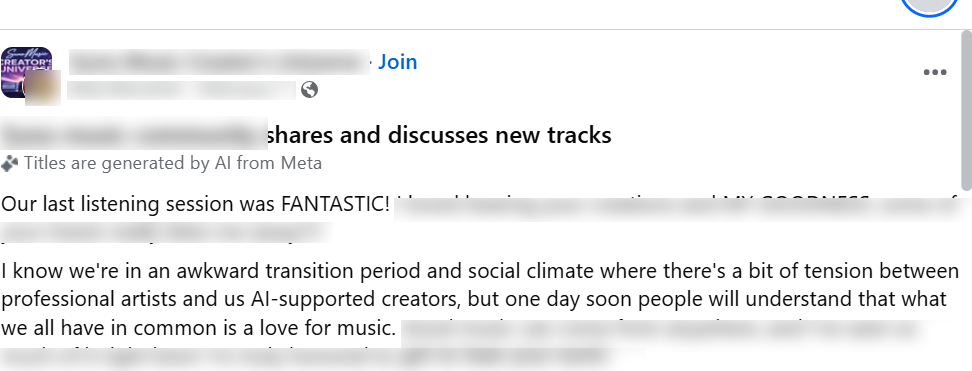
Key quote: “I know we’re in an awkward transition period and social climate where there’s a bit of tension between professional artists and us AI-supported creators, but one day soon people will understand that what we all have in common is a love for music.”
This is the AIgen-creative class forming in real time. The term “AI-supported creators” is the new identity label (replacing “prompter”). The framing puts AI-generated output on equal footing with human-made music (“good music can come from anywhere”). The listening session format mirrors real A&R/producer authority structures — critiques, curation, gatekeeping — all built on top of content none of them actually performed, produced, or played. 500+ submissions means this isn’t a fringe thing. It’s a full social infrastructure.
Suno Song Creators — Zealot 001 Streaming Numbers Post
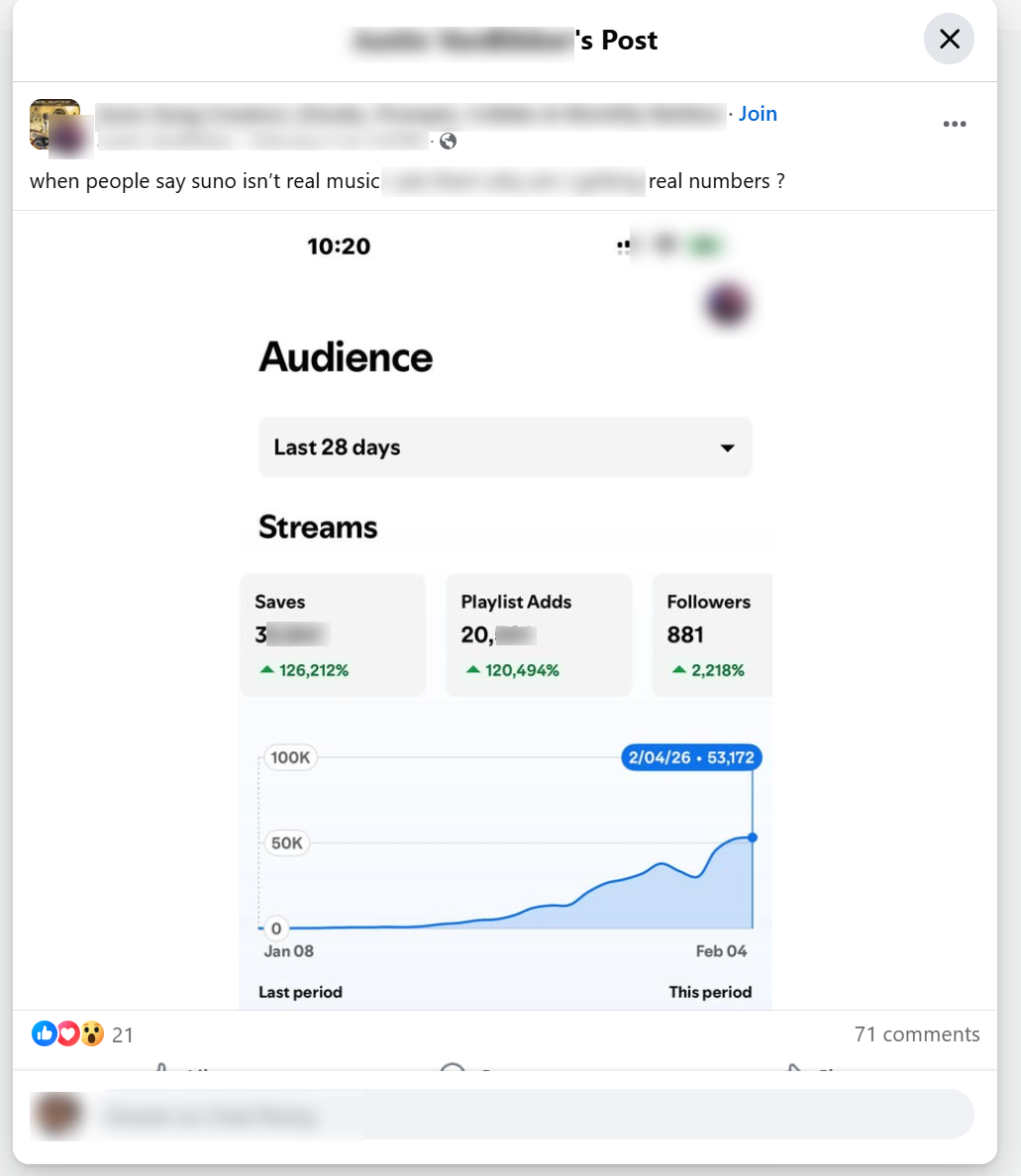
Zealot 001 posts his streaming dashboard with the caption: “when people say suno isn’t real music i ask them why am i getting real numbers ?” This is the “numbers = legitimacy” argument in its purest form. Streaming metrics are being used as proof that AI-generated music IS real music, as if algorithmic reach validates artistry. But numbers don’t prove something is music. Numbers prove something is content, content that an algorithm decided to push.
Spotify’s algorithm doesn’t evaluate craft, soul, or artistic intent. It evaluates engagement patterns. A well-optimized AI-generated track can trigger the same algorithmic levers as a human-made one. The algorithm doesn’t know the difference and doesn’t care. The numbers are real. The music question is irrelevant to them. This is like saying “my deepfake got 10 million views, so it’s real photography.”
This also reveals the deeper play: once AI-generated music is indistinguishable to algorithms (and increasingly to casual listeners), the entire streaming infrastructure becomes a laundering system for synthetic content. Real artists competing for the same playlist spots, the same algorithmic attention, against an infinite supply of machine-generated tracks optimized for engagement.
Zealot 001 Comment Thread Highlights (same post)
C1 backs him up with “next time, ask them if they take digital photos or if they are still using a film camera. Hahahaha!!!” — the classic false equivalence (digital camera still requires the photographer’s eye/skill/intent; Suno requires a text prompt). Zealot 001 cosigns: “facts.”
Then C2 (someone who may actually know photography) pushes back: “so you guys don’t know anything about film/photography either. Nice.”
Zealot 001’s response escalates into pure ego: “lol my music videos are 10xs better than anything you’ve ever created” → “written and directed by me and all of them have tens of thousands views… this is just my side quest i’ve also [artistic crafted] tons of celebrities and own one of the top three highest rated [craft] shops in [redacted].
Zealot 001’s response escalates into pure ego, challenging the commenter to compare business reviews, video views, and personal talent, bragging that his life story is the stuff books are made of and concluding that he is on his way to becoming “fuck-you rich.”
This is the synthetic accomplishment ego spiral in full bloom: the hostility when challenged, the pivot to unrelated credentials (artistic-craft shop, wealth), the grandiose self-mythology, all triggered by someone questioning whether AI-generated music is equivalent to human-made music.
Zealot 001 Instagram — Retirement from Artistic Craft
(@”Zealot 001”): “after [artistic craft-ing] for 22 years i’ll be retiring in two months.”
In the post, Zealot 001 announces his retirement from his 22-year career in a couple of months to focus on music full-time, noting that his physical shop will remain open under normal business operations while he prepares to move out of state.
This is the endgame of the synthetic accomplishment trap: a person walking away from a real craft they spent 22 years mastering, to pursue “music” that is generated by typing prompts into Suno. He’s not retiring to learn guitar. He’s not retiring to train his voice. He’s not retiring to produce. He’s retiring to prompt, and the streaming numbers (algorithmic, not earned through craft) gave him the confidence to do it. The ego inflation is making real-world life decisions.
[Third-Party AI Music All-In-One Workflow App]
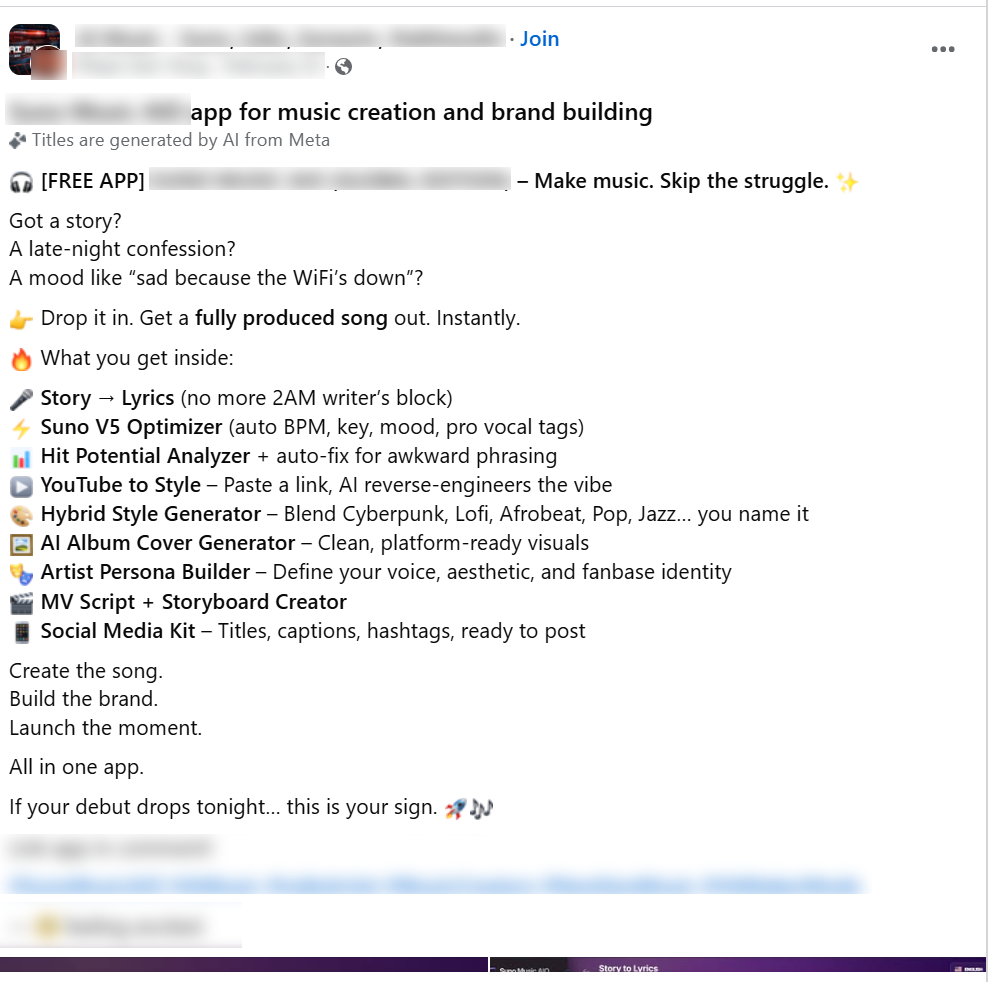
This is a free app/tool being shared in AI music communities that packages the entire creation pipeline into a single workflow:
- Story-to-Lyrics converter
- Suno V5 Optimizer (auto BPM, key, mood, pro vocal tags)
- Hit Potential Analyzer with auto-fix for awkward phrasing
- YouTube-to-Style reverse-engineering
- Hybrid Style Generator (blend genres like Cyberpunk + Lofi + Afrobeat)
- AI Album Cover Generator
- Artist Persona Builder
- MV Script + Storyboard Creator
- Social Media Kit (titles, captions, hashtags).
This is the full industrialization of the synthetic artist pipeline, an end-to-end identity factory. The tagline says it all: “Make music. Skip the struggle.” But the word isn’t struggle, as mentioned, it’s the internal process. The emotional, psychological, spiritual work of turning thought into form. That’s what these tools skip. They automate the entire persona, visual identity, marketing, and the “fanbase identity.” (WTF?) This is an artist-costume generator. Further proof that the AIgen-creative class isn’t as much about making songs as it is about manufacturing the feeling of being an artist without doing the internal work that makes someone one.
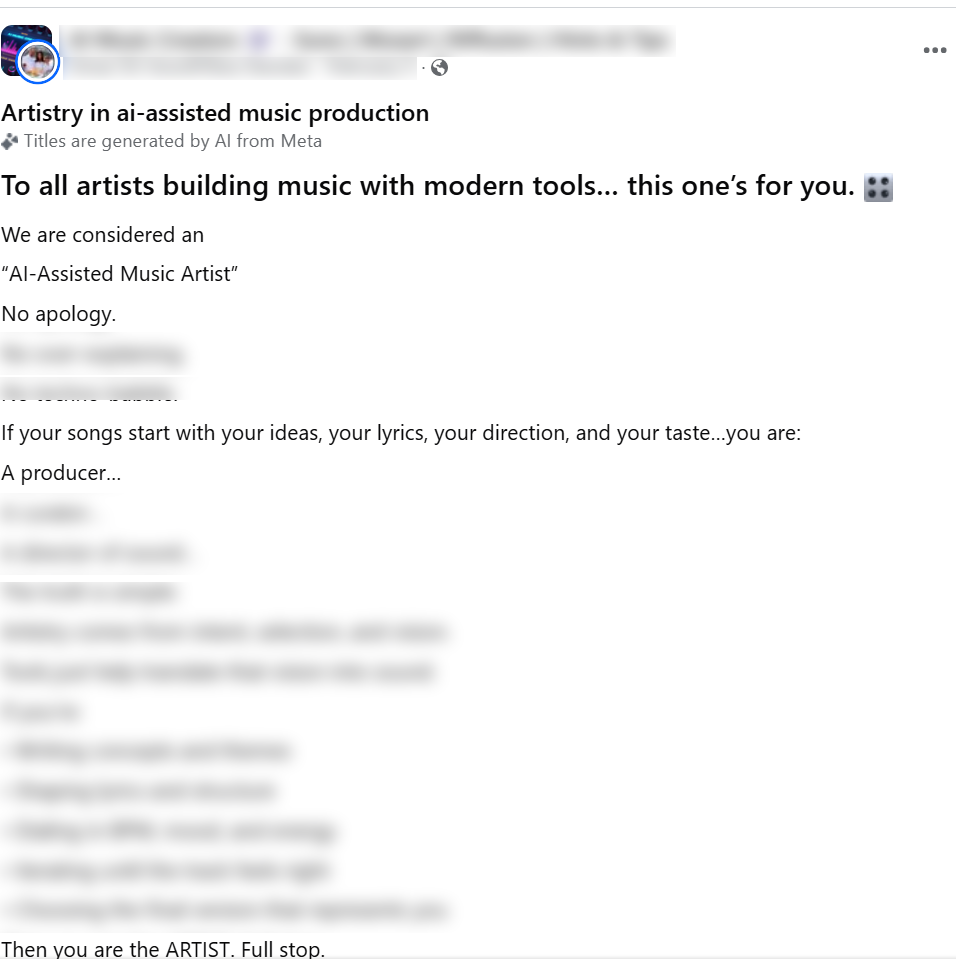
“AI-Assisted Music Artist” Manifesto Post — The Internal Rhetoric
This post is from a Suno-adjacent community and reads as a manifesto / rallying cry. It also uses AI-generated art as the post image. All-in on AI across every medium, not just music.
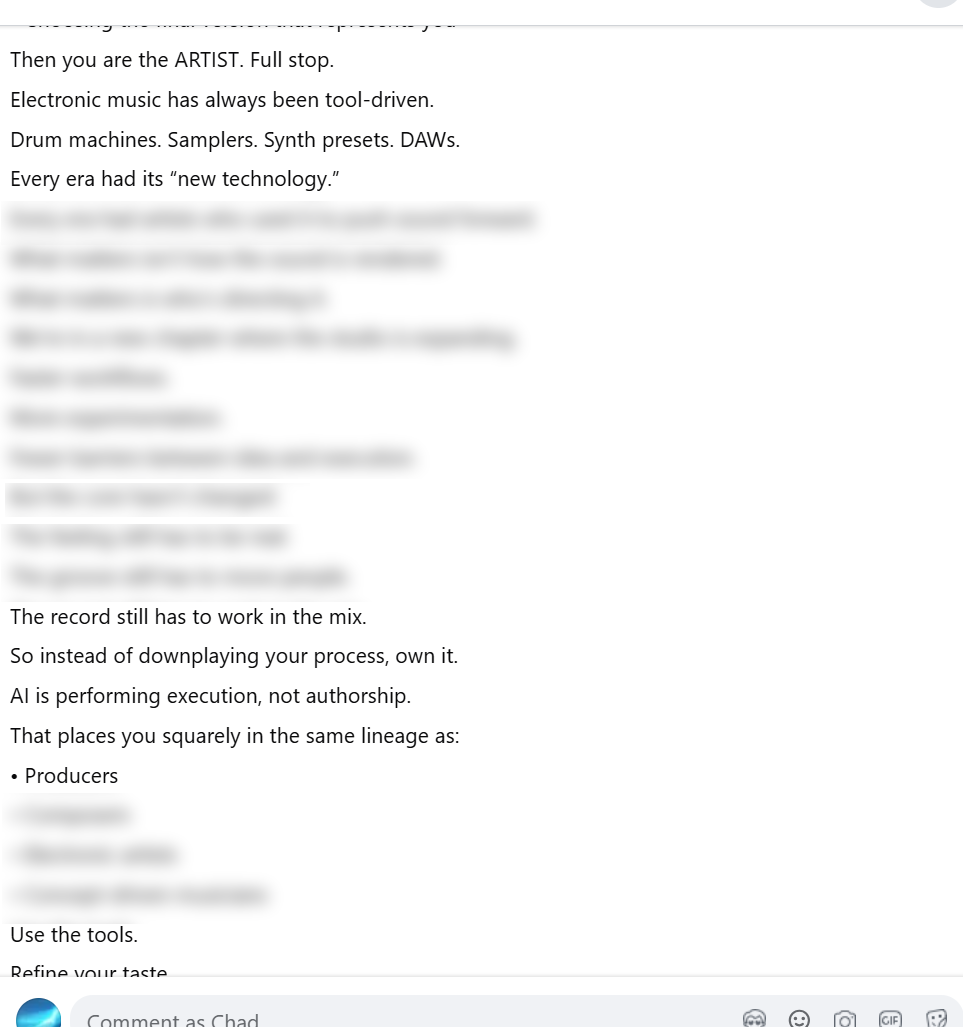
Excerpts from the post:
What this reveals:
This is the internal consensus document. The talking points the AI music community has settled on to defend their identity. It shows exactly where their reasoning stops and the self-deception begins.
The argument hinges on one move: equating selection with creation. “Artistry comes from intent, selection, and vision.” They’ve redefined artistry to exclude execution entirely. Under this definition, an A&R exec who picks which songs to sign is an artist. A Spotify playlist curator is an artist. Anyone with taste is an artist. The word loses all meaning.
The electronic music lineage argument is a common one, and it is foundational here. Yes, electronic music has always been tool-driven. But a producer using a drum machine is programming it: choosing each hit, each pattern, each velocity. A producer using a sampler is selecting, chopping, rearranging, layering. Both of these are hands-on manipulation of sound that require a human’s taste and mechanical input to complete. A DAW user is mixing, EQing, compressing, automating, making hundreds of micro-decisions that require trained ears and technical skill. A Suno prompter types “upbeat indie folk, female vocal, 120 BPM” and picks from generated options. The gap between those two processes is a canyon. Claiming the same lineage as electronic producers is like a passenger claiming the same lineage as a pilot because they both chose the destination or were aboard the same aircraft.
“AI is performing execution, not authorship.” This is a key sentence because it accidentally reveals the whole problem. In music, execution is a massive component of authorship. For example, the way a guitarist bends a note or the way a vocalist phrases a line. Execution is where the humanity is. When you outsource execution entirely to a machine, you’ve skipped the task that makes music yours. What you’re left with is a brief. A creative brief is not a song.
“The feeling still has to be real. The groove still has to move people. The record still has to work in the (DJ set) mix.” Yes, but none of these things are being done by a prompter, (and a record fitting into a DJ set is wholly unrelated.) The feeling is generated by the AI’s training data. The groove is algorithmically constructed. The mix is automated. The prompter’s contribution is: “I wanted it to feel this way.” Wanting something to feel a certain way is not the same as playing it, singing it or producing it to feel that way.
“Nobody dances to a tool. They dance to a vibe.” Also true, but the vibe was generated by the tool, not the prompter.
The hashtags tell are telling and perilous to creative-class culture: #IndependentProducer #ProducerLife #DJProducers. AIgen prompters are not considering the creation of a new identity, they’re entirely borrowing existing ones. They’re claiming that “we’re the same as the people who do it for real, and we demand the same title.”
Closing Remarks
It’s unclear how much the “real” or “organic artists” side of this conversation is investigating what’s happening inside the AI-gen music conclave. Both sides appear to be talking amongst themselves, but not with each other, or when they do, it’s at each other, usually through vitriolic fighting. Real artists are outraged in their spaces. AI creators are self-validating in theirs. Neither is engaging with the other’s actual arguments. Likely because no one is looking at the possibility of a world where both exist but neither are subjugated or superior, just distinct.
Fully generative AI music is here, and it’s here to stay. Instead of pointing fingers and dividing into camps, creating enemies and planning a pseudo war, it would benefit us to approach this with total honesty. That’s a big ask of society right now, but it’s my SOP. Humanity itself is being tested right now. We are being given a chance to decide how we treat each other based on how we use, approve or disapprove of technology like generative AI music. It would behoove us to develop a collective mindset on this before we get into AI that can print organic flesh, navigate nuclear weapons or simply, power the mind of the robot dog your neighbor has.
I believe the divide will continue before it amicably diverges or explodes, but my plea remains: be honest, be vulnerable, and express the depth of your feelings on the matter with respect to all participating in the discourse. Artists will always be artists, whether the name is co-opted or not. Imitation is now possible, but the very physical actions and existence of an artist is impossible to force or fake IRL. This act and existence of the artist will never cease, so long as humans are human. Keep humans human, and integrate technology for the betterment of all. Understand and appreciate technology for what it is, and admit what it is not, starting with AI generated music.