
There I was: 9 out of 10 items collected, thumb and forefinger cramped from holding the phone, hundreds of levels completed in a matter of hours— I could feel that virtual item in my virtual closet. The gameplay and interface led me to believe I was on the literal brink of winning that coat, but when the brink was just a cliff, it hit me: a visceral feeling of betrayal by big tech; I had been had.
Anxiety and boredom led me to start playing mobile games
The simple truth is that I wasn’t going to have access to Claude Code for 1-2 days, so I was going to have to find something to fill my time. The Anthropic coding agent was (and still is as of writing this) what my life enthusiastically revolved around at the time. That was how I was filling my time – building things. It was either building or streaming video.
My car had been repossessed, I didn’t have money to go out and do anything, let alone get to the thing, so I was stuck at home with nothing to do. After playing through four times, I got tired of the one video game I own (Zelda TOTK) and wanted something different. I hadn’t played mobile games since COVID, so I decided to see what kind of gaming experiences had been developed since then.
The Incestuous Advertising Schemes of Mobile Gaming
I landed on an iOS game called Yarn Loop, a colorful, well-developed and novel game. This fulfilled me and helped the time pass. I continued playing (less, but continued) once I was building again. Since I am not on social media, I was vulnerable to dopamine hits and this game slowly started becoming one. I was okay with it since it was mostly harmless, but a dopamine hit and anxiety-avoider nonetheless.
After playing for a few days, I started to notice the advertising system was especially inviting. Every ad was either for another game or for an app that paid you to play games. The ads for games were playable demos of the actual game being advertised. You could even download the advertised game right there from the ad. It was thrilling. It was genius. It got me.
Sometimes the ad was misleading and it would show the wrong game, the title of the game would be wrong, or the features would be missing. Between this lack of clarity/transparency and the general advertising scheme, this was where my skeptical cynicism began. Here are some facts about misleading in-game or for-game ads:
Facts
- The UK Advertising Standards Authority banned Playrix’s Homescapes and Gardenscapes ads in 2020: the ads showed a puzzle that was a sliver of the real game, and the “not all images represent actual gameplay” disclaimer didn’t save them. (PocketGamer.biz)
- The ASA banned an Evony ad on 3 April 2024 for showing a barrel-shooter when the game is city-building. (ASA ruling)
- ASA guidance, 22 August 2024: ads must show the game’s “core gameplay”, and disclaimers don’t protect a misleading ad. (ASA)
- The ASA can pull an ad after complaints but cannot fine. Nothing in the USA from the FTC.
Finding Hole Stars
While my first primary game was Yarn Loop, it was through one of their playable ads that I discovered Hole Stars. Let me tell you, Hole Stars is an exceptional product. The concept, design/development are world-class. This was what I was expecting six years of progress to yield: a true testament to leading-edge creativity and technology.
Hole Stars became my secondary game. Its rounds were much shorter compared to Yarn Loop’s, so it was still a novelty/break-from-Yarn-Loop activity for me. However, Yarn Loop was starting to become increasingly difficult—which is great for a game—but that difficulty was accompanied by a growing cynicism. As the game got harder, so did acquiring currency to buy lives so you didn’t have to restart grueling levels over and over. I was feeling the pressure to make IAPs to stay alive but I resisted. That resistance was funneled into Hole Stars, in which I was still in the early, carefree stages of its gameplay, which carried low pressure for IAPs.
Over the next few weeks, more of my attention went to Hole Stars. It became my primary game. I was so hooked that I eagerly paid the $9.99 fee to remove ads. Worth it. I was flying now. Not having to wait 30-120 seconds for an ad improved the experience threefold.
Fortunately, the game never took me away from actual work or life responsibilities, but something did eventually hook into my brain and demand more. After a few weeks of casually filling the Dreamy Closet, I found myself consciously planning to spend as much time as it took to complete the Dreamy Closet, a minigame/collection journey that you have 36 hours to complete, all or nothing.
The Dreamy Closet is a minigame within Hole Stars that is played by merging/matching elements on a grid to unlock apparel items in a virtual, illustrated closet. However, the elements don’t just appear on the board. After the first few freebies are used up, you must spend the mini game’s currency of “bows” to keep generating elements to merge and progress through the collection. Bows are earned in stints via a separate achievement journey called Bows Craze, which awards you bows in bulk for winning consecutive main-game levels “on the first try.” You also get one bow per level completed. As a reminder, there is no real world value you are collecting, it’s all virtual clothing and accessories in this game world, unlocked by currency you can only get by playing the main game or buying with real fiat dollars.
Another example of a minigame, one that was recently added towards the end of my run, is the Island Journeys (or something like that) which follows the main character, Piggy, through an illustrated world of obstacles and rewards. These rewards are actually helpful. They can be used in the main game, but again, you can only progress through Island Journeys by playing the main game to earn IJ’s own native currency of “potions,” which are spent unlocking gates and defeating enemies. Mind you, by defeating enemies I mean tapping a few times on the character and collecting your loot upon their one-click defeat. Same minigame device as Dreamy Closet, different illustrations and progress narrative. Same scarcity of minigame currency as difficulty rises, same push and pressure for IAP to get that dopamine hit of completion/progression.
Here are some facts about the rise of hybrid-casual core-loop-based gaming in response to Apple’s ad-tracking opt-in changes:
Facts
- After Apple made ad tracking opt-in in 2021, studios moved from ad-funded “hyper-casual” games to “hybrid-casual”: bolting progression systems onto simple core loops. A Voodoo publishing manager, 2021: meta-gameplay gives players “medium and long term goals.” (PocketGamer.biz, 23 Sep 2021)
- Naavik called hybrid-casual “the clearest way out” after the tracking change. (Naavik, 3 Oct 2023)
- Monopoly Go (Scopely) reached $5B in about 24 months, the fastest ever. One teardown counted about 25 event and offer types, 57% of events lasting one to two days, with one event’s reward feeding the next. (PocketGamer.biz; teardown, 30 Nov 2023)
- Researchers named time-limited pressure a “temporal dark pattern” in 2013 (Zagal, Bjork and Lewis). The EU consumer protection network cited “time-limited” purchase pressure in its March 2025 action against Star Stable. (European Commission)
- No public study measures how many players finish these events without paying. Player guides only.
| Game | Downloads | In-app purchases in a year |
|---|---|---|
| Subway Surfers | 250M | $9.8M |
| Survivor.io | 62M | $276M |
A quarter of the downloads, 28 times the money. (Naavik, 3 Oct 2023)
Here are some facts about ad fatigue and the curved cattle chute ushering players towards paying privilege to keep playing:
Facts
- Unity, one of the biggest ad networks in mobile games, 2021: hold interstitial ads until somewhere “from Level 3 to Level 8,” because “by waiting until a slightly later level, you can earn the engagement of the user and avoid the risk of causing them to churn at the first opportunity.” Then test higher ad frequency as long as revenue rises without hurting retention, and spare the players who pay. (Unity, 7 Mar 2021)
- Supersonic, May 2026: “Gradually introduce friction (challenge). Create moments where you can naturally show them what they need to succeed.” It also suggests giving a valuable reward through an ad once, then selling it only for money afterward. (Supersonic, 3 May 2026)
- A Hole Stars player review: “Zero ads until level 18. Then an ad after every. Single. Level.” Others report ads they couldn’t close and an X button that triggered the ad. (Game Solver, App Store reviews, anecdotal)
- 72% of the top 100 grossing mobile games run both in-app purchases and ads. (GameDevReports summary of Sensor Tower, vendor)
Paying Dearly For The Thrill
I never bought bows or potions themselves, but I spent around $10 on IAPs so I wouldn’t lose main-game upgrades that help the levels go faster—upgrades that can be taken away exponentially faster than they take to earn. It seems like you get one free “watch ad to keep playing” per day. After that, it’s 800 coins per life, which is the equivalent of $1-2. I spent another $10 over the course of a week or two, so that’s $20.
In Hole Stars, the upgrades are integral to progressing along in the game at an enjoyable rate. Once you get a taste of the speed and level-start bonuses, playing without them is undesirable. This is where the addiction peeks out. If you lose the level and you don’t have any lives left, and you don’t want to pay real money, you lose all the upgrades and have to win 10 more levels to get the upgrades back. The levels obviously get harder to beat without the upgrades, in addition to general difficulty as you climb. I was in the mid 500s by the time I was paying.
Oh, and mind you, I got the first $10 refunded from Apple because I complained that the gameplay changed after I paid to remove ads, the change being the increase in IAP pressure and I can’t confirm but it felt like I got less free “keep playing” chances than before I paid to go ad-free. Bastards.
Here are some facts on who pays for in-app purchases:
Facts
- Who pays: in the most concentrated mobile games, the top 1% of spenders produce about 38% of revenue and the top 10% about 78% (69 million players across 2,873 mobile games). (Close et al., 2023)
- Playtika (mobile social casino) saw its share of daily players who pay rise from 3.8% to 4.4% in 2025. (Playtika 10-K, company-wide figure, mostly mobile)
Betrayed by Big Tech (Surprise, surprise)
After playing over 100 levels with intention and commitment, I was hit with the resounding silence of the reward never arriving. The silent sound of a fictional, digital, unfinished closet. The only options were blindly marching on and playing an unknown number of additional levels to earn bows one by one, or buying however many more bows I needed, not even knowing how many that was. After a handful of rounds, the sinking feeling of disappointment evolved into betrayal, and I decided to delete the game. Something I genuinely loved had turned against me, and I decided I didn’t need the dopamine hit if it meant feeding a system that abuses me. I “choose lit, one of my songs” over that any day.
Here are some other aspects of these games that create and monetize addiction:
- “Streaks” – Logging in to keep your “streak” going. (shows investors higher monthly active users)
- “Missions” – These can range from simple “play 10 levels” to “watch 5 ads” and “make a purchase.” There are multiple versions of missions in these games, all with the same concept: play more and more and more and more, but they’re designed to make the less-aware players feel like they’re doing something different when they’re just playing the core game over and over.
- “Competitions” – Faux (I think) competitions that put you against other players and players that make it through the 7 or 10 rounds get a slice of a game currency reward. Usually not enough to buy anything meaningful in the game.
Here is a Facebook post I found that captures my feelings exactly. In fact, this post gave me the clarity I needed to decide on deleting the app.
Hole Stars Trading Group, Facebook, post dated August 24, 2026 (the post shows the closet with one item left, 0 bows, and 6h 28m on the event timer)
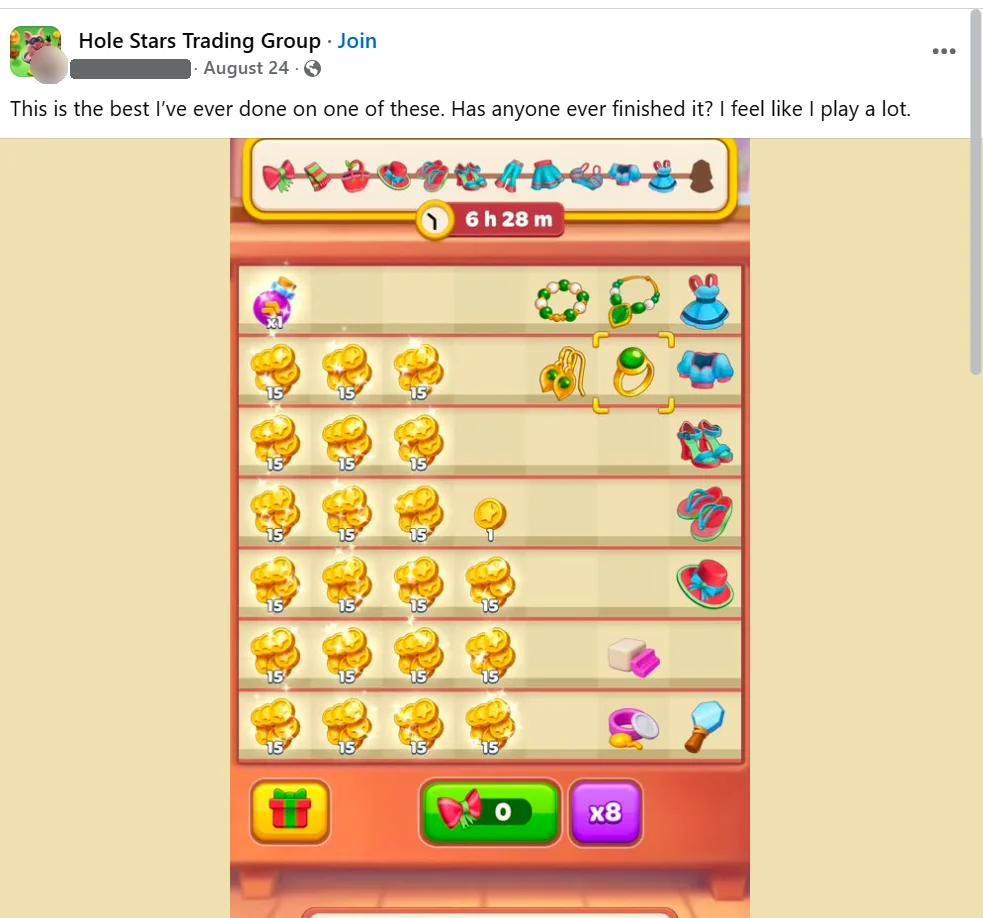
- I have never.
- Never
- The coat is 2048 bows
- I had almost 800 bows and didn’t finish. Ridiculous
- I usually finish.. it seems to take a lot!
- I finished one time & it took me buying extra bows to do it.
- I’ve gotten to the point where I just collect my 15 minutes of free play and then I just don’t do anything after that. I’m so frustrated happy for you though
- This game really is just for their own profit. ZERO incentive. Nothing has a purpose. Get crap when you pass a level. Once my coins are gone, I’m out.
One commenter posted a finished closet (“I did”).
How we got here
Here are some facts that depict what it looks like when we direct the world’s most creative minds to create capitalistic, attention-economy dopamine hit factories:
| When | What changed |
|---|---|
| September 2009 | Apple added the Top Grossing chart, which ranks by total spending. A free game with a few heavy spenders can outrank a $5 game that sells well. |
| 15 Oct 2009 | Apple allowed in-app purchases inside free apps. Before that, only paid apps could sell them. Apple pitched it as a replacement for “Lite” demo versions. (TechCrunch) Google followed in March 2011. (Critical allowance made here.) |
| First half of 2011 | Freemium games took 65% of revenue among the top 100 grossing iOS games, up from 39% six months earlier. (TouchArcade/Flurry) |
| 2014 | FTC settlements with Apple (at least $32.5M) and Google ($19M) over kids’ purchases without parental consent. Google stopped calling these games “Free” after EU pressure; Apple changed its “Free” button to “Get” on 19 Nov 2014. |
| 2017 and 2019 | Apple (Dec 2017) and Google (2019) began requiring loot box odds disclosure. |
| April 2021 | Apple’s App Tracking Transparency pushed casual games away from ads and toward in-app purchases (correlation plus mechanism, per Cheyre et al. 2024). |
| April 2025 | After the Epic v. Apple contempt ruling, publishers can link players to cheaper web shops in the US with no Apple fee. The money shifted between Apple and publishers; nothing changed about what players are sold. |
The pattern: every fix touched billing, labels or the fee split. None touched the ad ramp, the difficulty wall or the event calendar. An adult playing a game like Hole Stars sits almost entirely outside current US enforcement.
Not mobile-specific
- FTC v. Epic (Fortnite), Dec 2022: $245M in refunds over dark-pattern purchase design.
- FTC v. HoYoverse (Genshin Impact), Jan 2025: $20M, and no loot box sales to under-16s without parental consent.
- Brazil banned paid loot boxes for minors, effective 17 Mar 2026.
- Loot box spending correlates with problem gambling at r = 0.26 (meta-analysis, Garea et al. 2021). An association, not proof of cause.
The Profiteers
“Most of the world’s free time has now been monetized by tech companies.”
Ted Gioia said it well in his short essay “How Our Leisure Time Got Monetized”.
Facts
- Apple or Google takes up to 30% of every in-app purchase.
- Coin Master is the field’s standard example of slot-machine mechanics in a casual game, and the subject of academic criticism for hooking children. (ResearchGate)
- Hole Stars is Moon Active’s version of Voodoo’s 2018 game Hole.io. Its App Store listing: 16+, flags random-item purchases (loot boxes) and advertising, top in-app purchases $1.99 to $19.99, data used to track you. (App Store)
Here are some numbers on the intertwined companies behind these simple yet complex and addicting minigames:
| Hole Stars | Yarn Loop | |
|---|---|---|
| Made by | Moon Active, which also makes Coin Master | Spyke Games of Istanbul, under the Combo Games label |
| Moon Active’s stake | Its own game | 15.86% of Spyke, bought for $50M in May 2024 |
| In-app revenue | About $5M by July 2026 | Over $5.5M a month as of July 2026 |
| Daily players | 418,000 by July 2026 | No public figure |
Nothing found shows the Hole Stars ad inside Yarn Loop was a deliberate cross-promotion. It may have been ordinary ad buying. Sources: Hole Stars figures from an analyst newsletter (Carlos Pereira, secondary). Yarn Loop’s publisher from Gamigion, 31 Mar 2026, and its revenue is an AppMagic estimate (Gamigion, vendor estimate). The Spyke stake from Tech.eu.
All in all, I had fun, spent $20, and got used by the machine, one of my songs. Just another day in paradise, eh? There is no stopping these companies. The mindset is locked and the only goal is money. The people running these companies won’t change. What can change is the consumer. 1) Educating consumers about the depth of manipulation these companies exercise in hijacking our free will and 2) educating society about the depth of their anxieties and why we feel the need to spend so much time and/or money keeping ourselves distracted. The games themselves aren’t the problem. Games have existed since the dawn of man. The problem is the intentions and mechanisms behind the games, and the lack of awareness of it. That is the crack in the machine the Illus Caden is here to expose.