
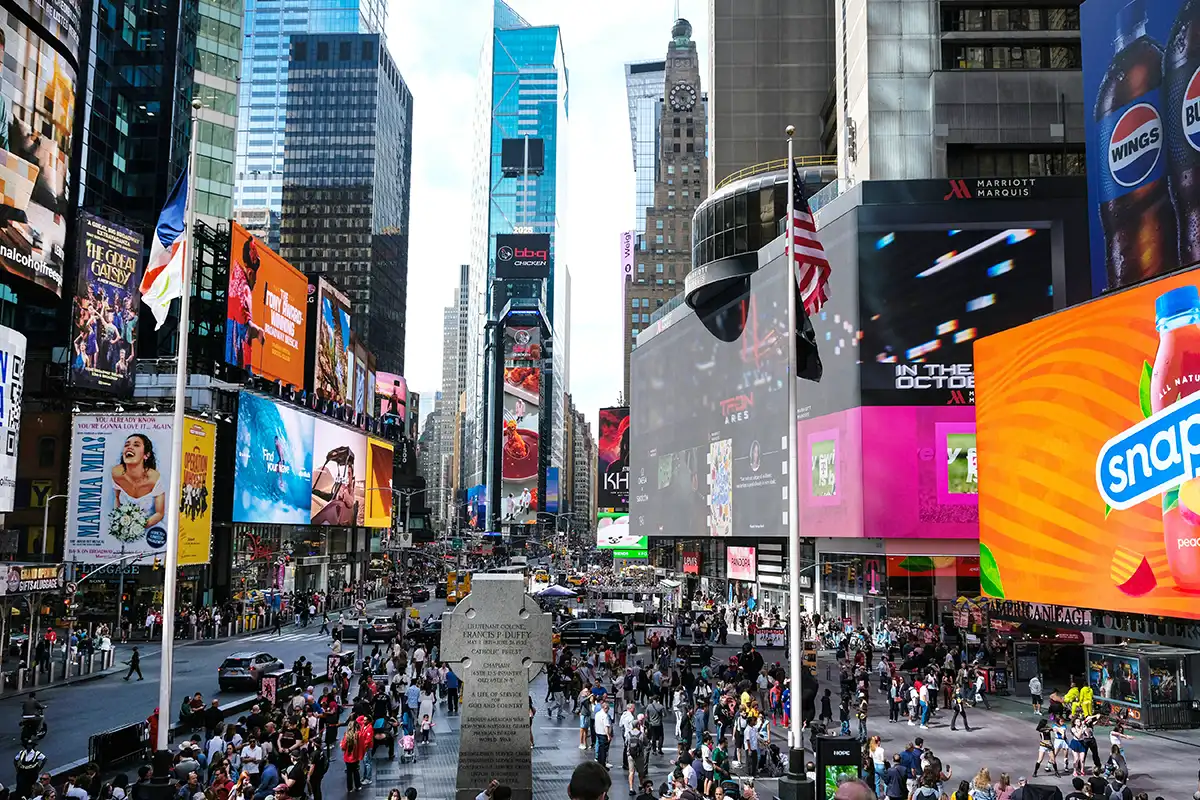
I’m constantly seeing musicians, book authors, general creatives and people of all kinds posting their videos about “Oh my god, I never thought I’d see myself on a billboard in Times Square!” The truth is, anyone can buy space on a few billboards in Times Square.
Digital billboards have been around for a long time, maybe 20 years or so, but self-service billboards came around only in the last decade. I even tried one of the early ones myself, a platform called Blip. Yes, my face and an obscure logo for a short-lived artist moniker “Ch5d” was on a few billboards in random-ass places around the country for 15 seconds at a time. I believed in this opportunity. I spent hours making variations of all sizes for all the different billboard dimensions, but I was ego-tripping. It did not help my career. I burned $100 and turned it off.

In 2019, when I did that, Blip was (and still is) positioned for businesses with a distinct product or service with a clear market to serve. Now, in 2026, we have billboards available for anyone, to display virtually anything, for very little money. In fact, the flood of videos happening right now is because one of those billboards is free.
Here are the three platforms available:
- TSX Broadway went live January 1, 2023, 18,000 sq ft, $40 for 15 seconds. 200,000+ app downloads in six months.
- The 1560 Broadway screen: $150 for 15 seconds every hour for 24 hours, resold as a tourist activity through Viator, Klook, and AAA.
- The T-Mobile screen at 1535 Broadway: free. A QR code on the screen texts you an upload link, and your photo is up in 15 to 20 minutes.
The Inflated Ego Loves a Good Billboard
This “OMG, I’m on a billboard in Times Square!” is one of the most obvious examples of inflating the ego, and it is ramping up. Social media has both given pre-existing inflated egos a place to run free and created more inflated egos by design. The presence of the inflated ego became prominent as social platforms moved towards “15 seconds of fame” content media—away from connecting with friends and family. Then came short form, and the presence of the inflated ego has since exploded.
I’ve seen this viral trend on all platforms, even LinkedIn, and I’m not even on social media like that. If I’m seeing it, it’s happening more and I’m guessing it’s happening more because the first few went viral and then people investigate how to do it, then more did it, and then companies like T-Mobile turn it into a campaign, giving away access free via a QR code, allow you to upload and see your photo right there on the spot. The problem with all the viral videos is that most viewers don’t know how cheap and easy or downright free it is to manufacture this moment. Most people viewing the viral videos are thinking that the person in the video is worth something because their face is on a billboard in Times Square, but the whole thing is fabricated. And not by some big company, by anyone who has the wherewithal to plan it out, or even stumble upon it on site.
What’s the Harm?
The problem with this is that we’re treating this as a success metric. “Billboard in Times Square” reads as “having made it” or that whatever is on the billboard must have great value, because that is what we’ve been trained to think about anything on a billboard. Most of the time, billboards carry content of value. When anyone can promote almost anything, the value of what is being promoted is irrelevant, it’s all about the social currency. This inflates the ego the same way that followers and likes do.
Followers and likes don’t actually help improve a person’s life; they inflate the ego. If those numbers reach high enough and they have something to monetize, they can make money from those numbers, but most of the time, numbers = status—not an improved lifestyle. Many posting on social media feed off of the numbers themselves, they aren’t even looking for money or status, the numbers ARE the goal. That is where the ego is clear. Numbers don’t help the body or the soul, they help the ego mind. They validate the person’s existence and at certain levels validate it to a level of fame, however niche it may be. This is an egoic goal.
The Missing Audience
Now apply what we know about social media numbers to the billboard. What does this billboard get this person other than the fact that their face was displayed in Times Square for 15 seconds? (Even if it’s 15 seconds every hour.) Besides the person in the billboard looking at their billboard in their trend video, who was actually looking at this billboard? How many people bought the book, bought the song or actually converted into a customer or even followed or subscribed from that billboard?
The answer is usually zero. Times Square Alliance counts 220,000 pedestrians a day. Divide by the 5,760 fifteen-second windows in a day and about 38 people arrive during your slot, spread across a district with dozens of screens, mostly facing the wrong one or looking at their phones.
That begs the question: is the person on the billboard the creator or the product?
These DIY self-serve micro-moment billboards are just bigger, public versions of the infinite scroll. Think about it. On social media, you submit your content into a lottery machine that throws it at a bunch of random people. Almost all of them scroll by, never remembering who you are. That is what is happening here. We are not talking about established creators that get pushed by the algorithm regularly, we are talking about everyday people with hopes and dreams. Even applying it to paid social ads, it’s an even closer match because you pay a small amount of money for your content to be shown to a random group of people hoping and praying some of them become customers. Without a huge budget, this is a total loss and if perpetuated, an ego trip.
In Times Square, just like social media, there’s no targeted audience looking at this billboard. It’s a bunch of random people looking at a bunch of random advertisements. The one difference is that everyone on social media is looking at the screen. Still, if we only include the people that saw the 15-second blip of the self-serve billboard, the math still holds. If you’re an unknown, billboards are not going to work. This is common knowledge in the marketing world. Unless you’re spending six figures or you’re selling a ubiquitous item, putting your face, book cover, album cover, etc, on a billboard, is not going to do anything. It reads as noise. Plus, the $40 screen prohibits self-promotion, plays no audio in the square, and allows almost no links. Even if you get someone else to buy it for you and manipulate it in some way, it is structurally incapable of converting anyone.
There are some novelty cases that don’t trip the ego meter, like a marriage proposal, a birthday or some other form of messaging that makes sense in a context that isn’t meant as an advertisement for the random people on the street, but those are few and far between.
The Times Square Self-Service Billboard Is an Egoic Lie
The “I’m on a Times Square billboard” is a fallacy, a farce, a trick of the ego. To anyone saying that it helps people feel better for one minute: that’s what the machine has been playing us on for decades; that “feeling better” for one minute is good for the soul because it gets you out of the anxiety of your mind or hopelessness but if that one minute of Escape is just an ego trip, what good is it actually doing? The fall from a dopamine hit of seeing your face on a billboard to not having anything good happen to you after that might be worse than never having seen it at all. Anyone who doesn’t feel the fall may have been looking for ego inflation anyway. Anyone looking for an ROI is going to wonder where it is.
Most people involved in these, beyond the fun family photo, are never going to be able to see that that’s all it was a trick of the ego. This trend of buying 15 seconds on a billboard in Times Square so you can post it online is a prime example of how we’re taking our real world self for granted in the hopes of improving our virtual avatar self. This is tricking people into feeling better for a minute when they’re actually just being inflated artificially. That’s the crack in the machine this article illuminates: the 15-second billboard in Times Square is an ego trip and nothing more.
Photo by ubeyonroad on Unsplash